
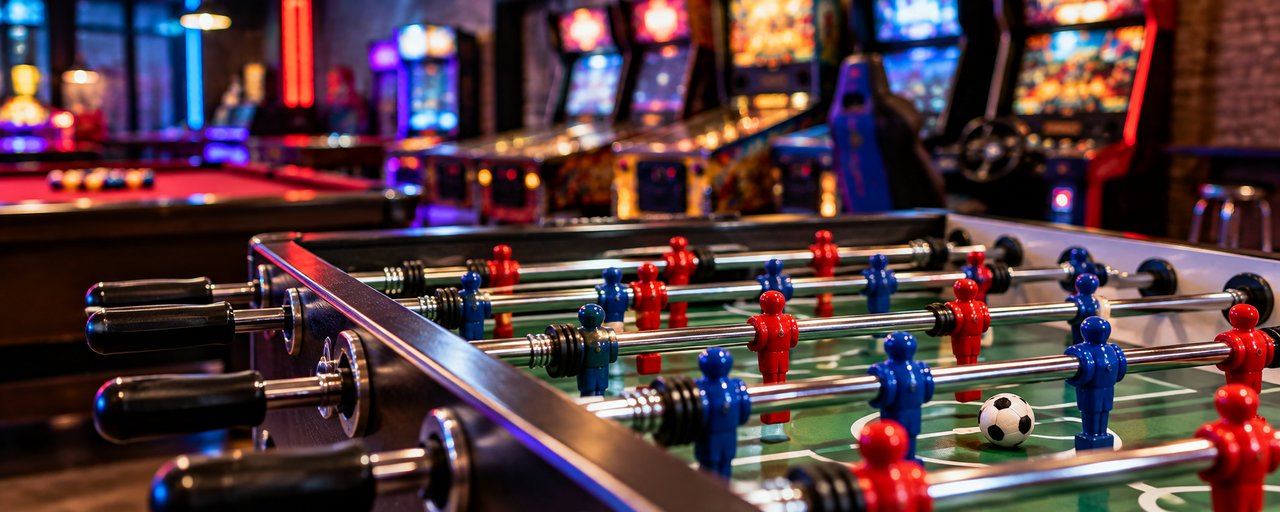
Casual table soccer and competitive foosball are two completely different sports wearing the same jersey. One is a rec-room pastime with a wobbly rod and a dead spot near the goal. The other is fast rods, tight passing lanes, and a ball that never slows down. If you're building a setup for real matches, not just party small talk, your table has to keep up with your reflexes, not fight against them.
That's where Game Exchange of Colorado comes in. As a trusted dealer for tournament-grade brands like Tornado, Valley-Dynamo, Legacy Billiards, and Brunswick, we've spent decades sourcing, restoring, and setting up tables that can actually handle serious play. Here's your scouting report on what makes a foosball table "competitive-grade," which models earn a spot in that category, and how to build a setup that rewards skill instead of punishing it.
Casual Toy or Tournament Tool? Know the Difference First
Not every foosball table sold online is built for real matches; most are lightweight, hollow-cabinet units designed for looks, not longevity. A genuine competitive-grade foosball table is a different machine entirely: heavier gauge steel, a warp-resistant playfield, and rods that don't flex under a hard shot.
The giveaway signs of a tournament-ready table are consistent across every serious brand:
1. Counterbalanced foos men that stay horizontal instead of drooping into passing lanes
2. Hollow, heat-treated steel rods that deliver speed without sacrificing rigidity
3. A laminate playfield with zero dead spots and consistent ball roll
4. Commercial-grade cabinet weight (usually 150+ lbs) that won't shift mid-match
If a table is missing two or more of these, it's a living room accessory, not a training tool.
Playing by the Rules: What “Regulation” Actually Means
Serious players eventually run into the word “regulation”, and it's not just marketing language. A regulation-standard table generally runs close to 56 inches long, 30 inches wide, and 36 inches high, mirroring the dimensions used in official tournament play. That size isn't arbitrary, it's what gives players enough rod travel and passing lane width to execute real shots instead of cramped, awkward taps.
If you're practicing for league play or building a home setup that should feel identical to a tournament table, matching these dimensions matters more than almost anything else on the spec sheet.
Rods, Men, and Bearings: The Anatomy of a Tournament Table
Every advantage on a competitive table comes down to engineering, not aesthetics. Here's what separates a table that helps your game from one that gets in its way.
|
Table Component |
Competitive Engineering |
Why It Matters in a Match |
|
Rods |
Hollow, chrome-plated steel |
Faster wrist snaps, less fatigue over long matches |
|
Men |
Counterbalanced, textured feet |
Better ball pinning, cleaner passing lanes |
|
Playfield |
Down-corner laminate construction |
No dead spots, consistent ball speed |
|
Cabinet |
Heavy-gauge, reinforced frame |
Stays planted through aggressive shots |
|
Bearings |
Sealed, low-friction rod bushings |
Smooth lateral slide for tic-tac passes |
|
Scoring |
Manual beads or electronic counter |
Fast, dispute-free score tracking mid-rally |
Quick Notes:
1. Rods: Hollow steel rods are the standard on nearly every competitive table for a reason; they're lighter, which means faster reaction speed and less arm fatigue during long matches, without losing the rigidity a solid rod offers. The tradeoff is minor durability under extreme abuse, but for match-speed play, hollow rods win almost every time.
2. Goalie Setup: Most American-style competitive tables run a 3-man goalie configuration. It keeps the ball moving, reduces awkward corner retrievals, and rewards the fast passing and bank-shot strategy that defines high-level American foosball, which is exactly why it's the standard across our lineup.
Game Exchange of Colorado’s Starting Lineup: 5 Best Foosball Tables for Competitive Play
Here's our pick of models from the current foosball table lineup that are genuinely built for tournament-level intensity, not just tournament-level looks. Each one earns its spot through the same lens: rod speed, cabinet durability, and how well it holds up when a match goes into overtime.
01 | Tornado Elite Foosball
The flagship pick for players who want zero compromises. This is the same engineering DNA found in official tournament halls, with the rod speed and durability to survive daily competitive drilling. If your practice sessions look more like training camp than casual play, this is the table that keeps pace, built to hold its edge even after months of aggressive, back-to-back matches.
02 | Torn T3000 Tour Edition Coin-Op Foosball
Built for venues that need tournament accuracy with commercial-grade coin mechanics. If you're anchoring a bar, rec center, or league night, this is the workhorse that won't quit, engineered to take constant rotation without losing its competitive edge, even when it's running matches from open to close.
03 | Tornado Sport II
The best entry point into serious play, sharp enough for competitive practice, priced for players who aren't ready for flagship money yet. It's the table most players graduate to once casual matches stop cutting it, offering a real taste of tournament-speed rods without the flagship price tag.
04 | Tornado Classic II
A durability-first choice with a heavy-duty build that handles aggressive, high-frequency play without loosening up over time. A solid pick for anyone who plays hard and doesn't want to babysit their equipment, the cabinet and rod assembly are built to stay tight match after match.
05 | Striker Foosball by Brunswick
Proof that competitive features don't require a flagship budget: single-man goalie design, counterbalanced players, and wear-resistant rod bearings in a leaner package. A smart way to start building a serious setup without maxing out day one, especially if you're still deciding how deep you want to go into competitive play.
Each of these ships from our arcade equipment showroom, and every unit, new or refurbished, goes through our full inspection process before it reaches your door.
New vs. Refurbished: Building Your Foosball Roster on Any Budget
You don't need a flagship-only budget to build a competitive setup. A hybrid approach, one standout table paired with a certified refurbished unit, gets you tournament performance without tournament pricing.
|
|
New Tables |
Refurbished Tables |
|
Best for |
Players who want zero wear, latest finish |
Budget-conscious players, high-traffic spaces |
|
Warranty |
Full manufacturer coverage |
Game Exchange of Colorado Certified Limited Warranty |
|
Performance |
Factory-fresh precision |
Restored to match new-table specs |
|
Value |
Premium investment |
High ROI, pro-level play at a lower entry cost |
Every refurbished table we sell goes through rod alignment, bushing replacement, playfield calibration, and OEM part swaps before it's certified match-ready, so “pre-owned” never means “second-rate” on our floor.
Budget-wise, expect entry-level competitive tables to start around $1,100, mid-tier tournament-capable models in the $2,000–$2,700 range, and flagship coin-op or tour-edition units topping out near $3,200. Where you land depends on whether you're outfitting a personal practice space or a venue that needs to survive daily match traffic.
Set the Stage: Space and Surface Requirements for Real Matches
A competitive table needs room to breathe. Cramped corners kill rod extension and turn clean shots into wall-clipping accidents. For serious play, plan on a dedicated area of at least 7x8 feet, enough clearance for full rod pull-back and comfortable elbow room on both ends.
Beyond space, surface matters more than most players expect:
1. Level flooring keeps the playfield true and prevents ball drift toward one goal
2. Consistent lighting across the table eliminates shadow zones that slow reaction time
3. Non-carpeted footing near the cabinet legs prevents wobble during aggressive shots
These aren't luxury upgrades; they're the difference between a table that plays fair and one that quietly sabotages your best shots.
Keep the Table Match-Ready: 5 Maintenance Tips to Protect Your Edge
Even the best competitive table degrades under serious use if it's ignored. A few habits keep your rods, bearings, and playfield performing like day one:
1. Wipe the playfield weekly to prevent dust buildup that slows ball speed
2. Check rod bushings monthly for early signs of friction or drag
3. Tighten cabinet hardware quarterly, especially after heavy tournament use
4. Wax the playfield every few months to maintain consistent ball roll
5. Lubricate rod bearings with a light silicone lubricant, never an oil-based product that attracts dust and grit
6. If a table starts feeling sluggish mid-season, our parts and service team can source OEM components to bring it back to tournament spec.
Test It, Then Trust It: Building a Setup That Plays as Hard as You Do
Choosing between models is easier when you've actually played on them. Our rentals program lets you bring a competitive-grade table into your space for a trial run, a league night, a corporate event, or just a few weeks of real practice, before making it permanent.
At the end of the day, a competitive foosball table isn't defined by its price tag. It's defined by whether it disappears during play, letting your skill decide the match instead of a loose rod or a dead playfield spot.
Since 1980, Game Exchange of Colorado has helped players and venues source exactly that kind of equipment, backed by a 12,000+ Sq. Ft. Showroom where you can test-play before you buy and White-Glove delivery that gets your table tournament-ready from day one.
Whether you're outfitting a home practice space or anchoring a league night venue, the right table is out there, and it's probably already on our floor.
Frequently Asked Questions
1. What makes a foosball table "competitive-grade" instead of a toy?
It comes down to build quality, hollow steel rods, counterbalanced men, and a warp-resistant laminate playfield. These features keep gameplay fast and consistent, unlike lightweight retail tables that flex and slow down under real match pressure.
2. Do I need a coin-op table for competitive practice at home?
No, most coin-op and commercial tables can be switched to free play, giving you the same rugged build and tournament feel without needing coins for every match at home.
3. How much space do I actually need for serious play?
Plan for at least 7 x 8 feet of dedicated floor space. This accounts for full rod extension on both ends plus comfortable elbow room during fast-paced rallies.
4. Is a refurbished table good enough for competitive training?
Yes, as long as it's professionally certified. Our refurbished units go through rod alignment, bearing replacement, and playfield calibration, restoring them to near-new performance at a lower price point.
5. What's the biggest maintenance mistake competitive players make?
Ignoring the rod bushings. Worn bushings cause drag and uneven rod movement, which throws off passing accuracy long before players notice the table has degraded.